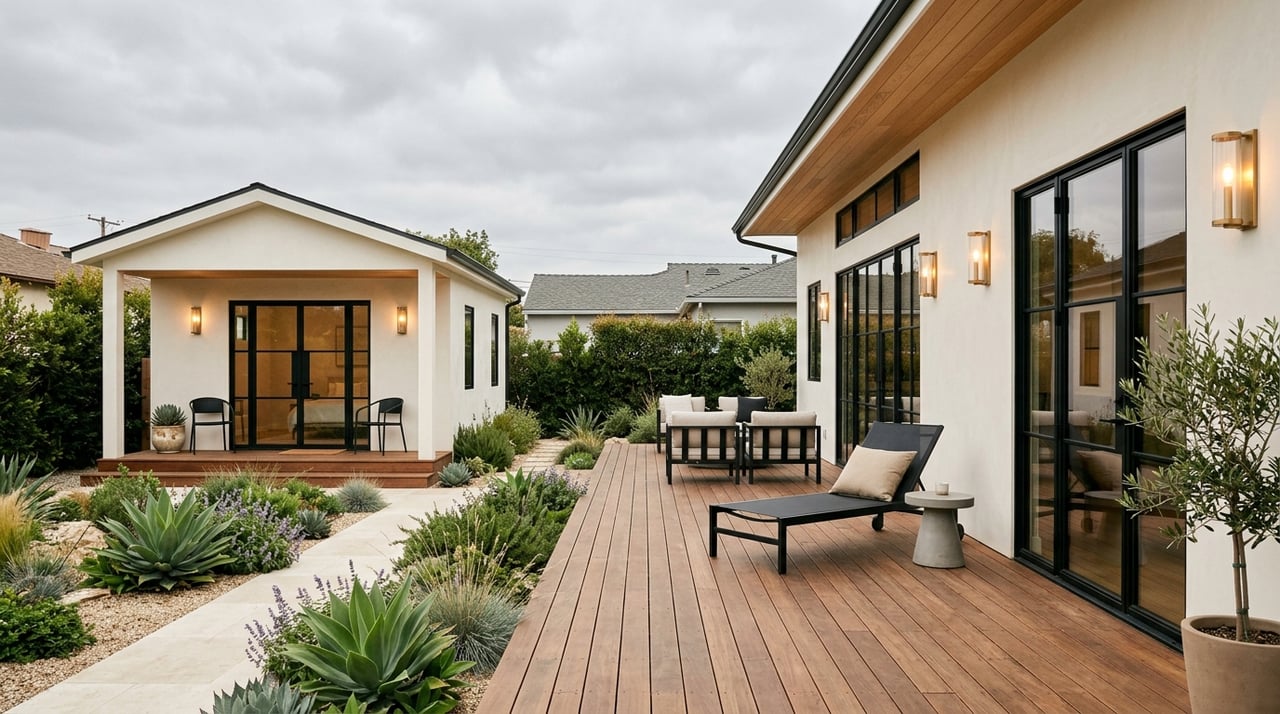
If you have ever looked at your Redwood City property and wondered whether that garage, side yard, or backyard could do more, you are not alone. Many homeowners are exploring ADUs and in-law units as a way to create flexible living space, support family members, or add rental income in a market where housing costs remain high. The good news is that Redwood City is relatively ADU-friendly, and understanding the basics can help you see what may be possible on your lot. Let’s dive in.
What an ADU Means in Redwood City
In California, ADU is the legal term for a smaller, self-contained home on the same property as a main residence. You may also hear it called an in-law unit, granny flat, backyard cottage, or secondary unit.
In Redwood City, both ADUs and JADUs can play a role. A JADU, or junior accessory dwelling unit, is typically a smaller unit created within the walls of an existing home. For many homeowners, the informal phrase “in-law unit” is simply another way of describing one of these setups.
Why ADUs Matter Right Now
ADUs are popular for two main reasons: flexibility and value. You might use one for extended family, a caregiver, adult children, or long-term rental income while keeping privacy between the main home and the second unit.
That flexibility matters in Redwood City. The city reports a 2024 population of 84,292, a median rent of $2,899, and an average one-bedroom rent of $2,846, which helps explain why smaller, well-designed housing options continue to attract attention.
Redwood City ADU Rules to Know
Before you get too far into design ideas, it helps to understand the local framework. Redwood City has rules that are generally favorable to homeowners, but each property still requires site-specific review.
Single-family property allowances
On a single-family lot, Redwood City allows:
- One ADU
- One JADU on the same property
That means some homeowners may be able to create two separate secondary living spaces, depending on the layout of the home and lot.
Multifamily property allowances
On multifamily parcels, Redwood City allows:
- Conversion of non-habitable space for at least one ADU or up to 25% of the existing units
- Up to two detached ADUs with 4-foot setbacks
This can create meaningful opportunity for owners of duplexes or other multifamily properties who want to add usable housing space.
Size limits for detached ADUs
Redwood City states that detached ADUs can be up to:
- 850 square feet for one bedroom
- 1,000 square feet for more than one bedroom
- 1,200 square feet if accessibility standards are met
If you are considering a two-story design, the city brochure notes that second-story portions are limited to 600 square feet.
Parking, fees, and rental rules
These details often shape whether a project feels manageable.
Parking is simpler than many expect
Redwood City does not require additional or replacement parking for ADUs. For many homeowners, that removes one of the most common concerns tied to garage conversions or backyard construction.
Some fees may be reduced
The city exempts ADUs under 750 square feet and all JADUs from development impact fees. That can make smaller units especially attractive from a budgeting standpoint.
Still, some costs may remain. Redwood City notes that water and sewer capacity fees, address fees, and fire-flow test fees may still apply.
Short-term rental use is restricted
If your goal is a vacation rental or Airbnb-style setup, this is an important point. In Redwood City, new ADUs and JADUs cannot be used as short-term rentals.
For JADUs, state rules add another layer. If a JADU is rented, it must be rented for more than 30 days.
Which Redwood City lots have the best potential
Not every property is equally easy, but some lot features tend to make ADU plans more realistic.
Easier lot characteristics
In general, some of the strongest ADU candidates have:
- Good rear-yard depth
- Side-yard clearance
- An existing garage or accessory structure
- Straightforward utility access
- Simpler foundation conditions
These traits line up with Redwood City’s setback rules and with the city’s note that site conditions can affect feasibility.
Site issues that can complicate projects
Redwood City notes that certain property conditions may require closer review, including:
- Hillside conditions
- Bay-mud foundations
- Wildland-urban-interface areas
- Fire-flow requirements
- Flood zones
- Utility location issues
- School-district coordination
This is one reason an ADU that looks simple on paper can vary quite a bit in cost and timeline once plans are underway.
Garage conversions are often the easiest path
For many Redwood City homeowners, a garage conversion or interior conversion is the most cost-efficient route. If the structure already exists and is close to code requirements, you may avoid some of the complexity of a fully detached new build.
State guidance is especially helpful here. No setback is required for an ADU or JADU created within an existing living area or accessory structure, or for an ADU rebuilt in the same location and to the same dimensions as an existing structure.
If you expand that structure, though, Redwood City’s local rule still applies. Expansions must respect the 4-foot side and rear setback requirement.
What ADUs can cost in San Mateo County
Cost is usually the first practical question. San Mateo County’s ADU Resource Center offers a rough budgeting placeholder of $450 to $600 per square foot for construction, design, and fees, with soft costs often running about 15% of the total budget.
Using that range, the planning math looks roughly like this:
- 400-square-foot JADU or garage conversion: about $180,000 to $240,000
- 600-square-foot ADU: about $270,000 to $360,000
- 800-square-foot ADU: about $360,000 to $480,000
Those are planning estimates, not guaranteed project totals. Costs can rise with higher-end finishes, difficult site conditions, utility work, or structural upgrades.
The county also notes that school-district fees may apply above 500 square feet, and development impact fees may apply above 750 square feet. In Redwood City, local rules are somewhat more favorable because ADUs under 750 square feet and all JADUs are exempt from development impact fees.
How long the permit process may take
Timeline matters, especially if you are trying to coordinate construction with a move, a family need, or an income plan.
Redwood City says its pre-reviewed ADU plans can reduce local permit review to 30 days, although each site still goes through planning and building review. Separately, state law requires agencies to determine whether an ADU application is complete within 15 business days and to approve or deny a complete application within 60 days, subject to tolling rules.
Beginning May 1, 2025, Redwood City also requires a homeowner survey to finalize an ADU building permit. The city uses that survey to collect data on ADU rents and use.
What rental income might look like
Rental income is one of the biggest reasons homeowners consider building an ADU. While no one can promise a fixed rent level, local and regional numbers provide a useful framework.
Redwood City reports an average one-bedroom apartment rent of $2,846 and a median rent of $2,899. The Terner Center’s California ADU survey found a median new ADU rent of about $2,200 in the San Francisco Bay Area.
Taken together, those figures suggest that a legal, well-finished Redwood City ADU could plausibly rent in the mid-$2,000s to low-$3,000s per month, depending on size, privacy, parking, and finish level. The exact number will vary by property and layout.
How ADUs may affect resale value
A permitted ADU can make a home more flexible and more marketable, but it is smart to think about value in a measured way.
FHFA’s 2025 California analysis found that properties with ADUs had a median appraised value of $1,064,000 in 2023, compared with $715,000 for comparable properties without ADUs. FHFA also found faster annualized growth over the 2013 to 2023 period for homes with ADUs.
That said, the safest takeaway is simple: a permitted ADU often supports value and marketability, but the increase does not always match total construction cost dollar for dollar.
Why permits matter for buyers and sellers
If you are buying a home with an existing in-law unit, the legal status matters. A permitted ADU usually brings more certainty than informal or unpermitted space.
Fannie Mae requires appraisers to describe an ADU and analyze its effect on value or marketability. If an addition lacks permits, the appraiser must comment on its quality and market impact. Freddie Mac also requires documentation of the ADU’s size, condition, and legal status when it is used in underwriting.
For sellers, this means permits can matter during valuation, buyer confidence, and financing review. For buyers, it means due diligence is especially important when a listing mentions an in-law unit or converted garage.
Property tax impact to plan for
An ADU can improve usefulness and resale appeal, but it may also affect your property taxes.
San Mateo County’s Assessor says new construction is assessed at market value when completed, while the existing land and other structures not involved in the new work are not reassessed. In plain terms, the added value from the ADU is added to the current assessed value, rather than resetting the full tax base of the original home.
When an ADU makes strategic sense
An ADU project is not just about whether you can build one. It is also about whether the investment fits your goals.
It may make sense if you want to:
- Create space for extended family or long-term guests
- Add long-term rental income
- Improve your property’s flexibility before resale
- Buy a home with clear ADU potential for future use
- Convert existing space more efficiently than building new square footage in the main home
In many cases, the best opportunities are properties where the lot layout, budget, and intended use all align.
If you are weighing whether to buy, sell, or improve a property with ADU potential in Redwood City, it helps to evaluate the lot, permit path, likely costs, and resale implications together. That kind of early strategy work can save time, money, and second-guessing later on.
Whether you are looking for a home with room to add an in-law unit or deciding how ADU potential could affect your sale, working with a local advisor can make the process much clearer. To talk through your options in Redwood City and the Mid-Peninsula, connect with Debbie Elowson.
FAQs
What is the difference between an ADU and an in-law unit in Redwood City?
- In most local and California real estate contexts, “in-law unit” is an informal term people use for an ADU or JADU.
Can you build both an ADU and a JADU on a single-family lot in Redwood City?
- Yes. Redwood City allows one ADU and one JADU on the same single-family property.
Does a Redwood City ADU require extra parking?
- No. Redwood City does not require additional or replacement parking for ADUs.
Can a Redwood City ADU be used as an Airbnb or short-term rental?
- No. New ADUs and JADUs in Redwood City cannot be used as short-term rentals, and rented JADUs must be rented for more than 30 days.
How much does it cost to build an ADU in Redwood City?
- A San Mateo County budgeting placeholder is about $450 to $600 per square foot for construction, design, and fees, with total cost depending on unit size, site conditions, and finishes.
How long does ADU permitting take in Redwood City?
- Redwood City says pre-reviewed plans can reduce local permit review to 30 days, and state law requires completeness review within 15 business days and a decision within 60 days for a complete application.
Do garage conversions for ADUs need setbacks in Redwood City?
- Not if the ADU is created within an existing structure or rebuilt in the same location and dimensions, but any expansion must follow the 4-foot side and rear setback rule.
Does a permitted ADU help resale value in Redwood City?
- A permitted ADU often improves value and marketability, but the increase is not guaranteed to equal the full cost of construction.