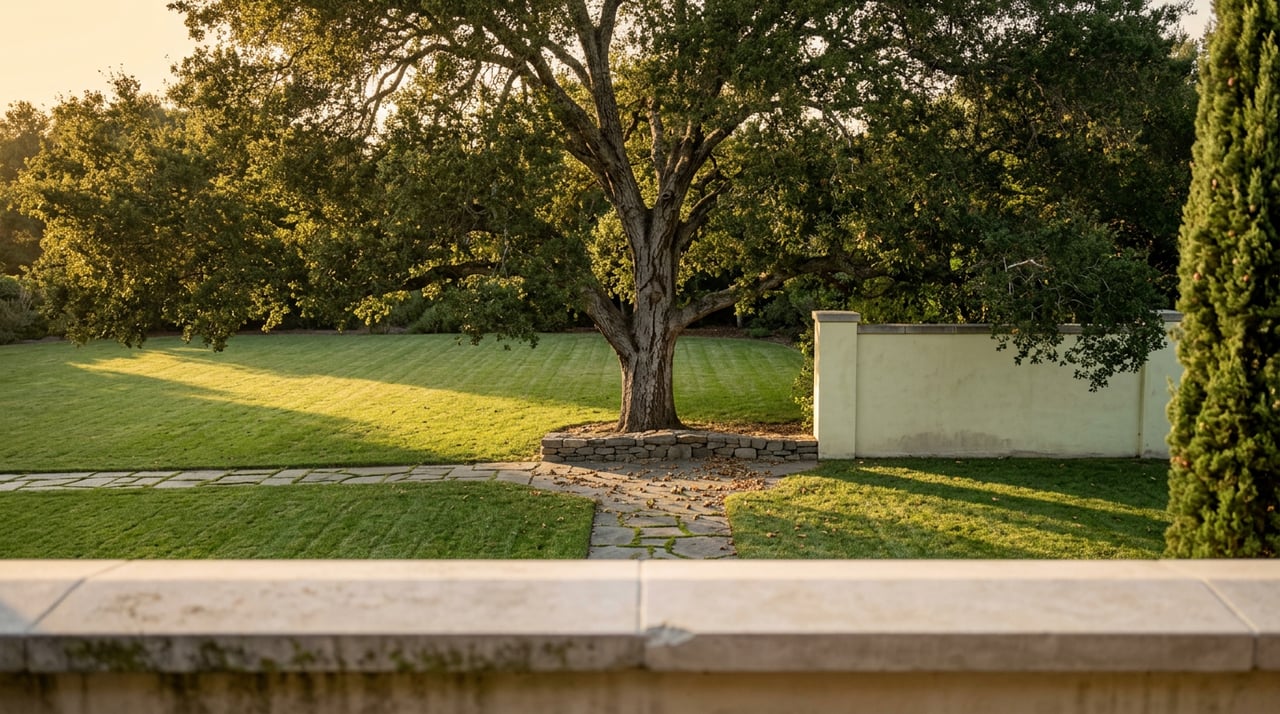
A one-acre lot sounds like room to build almost anything. In Atherton it often isn't, and the reason has nothing to do with setbacks, height limits, or the Architectural Review Committee everyone already expects to deal with. It has to do with a tree most buyers walk right past during a first showing.
Atherton's acre-minimum zoning and its refusal to allow any commercial development are well-known parts of the town's character, as detailed in a CustomHome.us guide to building a custom home in Atherton. Less understood is what happens when a buyer under contract commissions a lot survey and discovers, as a Town of Atherton staff report on the ordinance explains, that a single oak near the property line has quietly claimed a 25-foot-wide circle of the yard before an architect has drawn a single wall. That circle is not a suggestion. It is a legal protection zone defined in the town's own code, and it can sit directly on top of where a buyer planned to put a pool, a garage addition, or the new wing that justified the purchase price in the first place.
For a market where acquiring a legacy lot and rebuilding on it is a routine strategy, this is the diligence item that belongs on the list before the inspection contingency expires, not after.
What Actually Counts as a Heritage Tree in Atherton
Chapter 8.10.020 of the Atherton Municipal Code defines a heritage tree with more precision than most buyers expect, and more paths to qualifying than most buyers assume.
An oak (valley oak, coast live oak, or blue oak) or a redwood counts if it measures at least 48 inches in trunk circumference, or roughly 15.2 inches in diameter, measured 54 inches above natural grade, no matter where it sits on the lot. Any other tree species of the same size qualifies too, as long as it sits outside the parcel's main buildable area. And size is not the only test. A native oak can qualify by age alone at 75 years. Any other species can qualify at 45 years. A redwood needs only 30 years.
| Qualifying path | Threshold |
|---|---|
| Oak or redwood, anywhere on the lot | 48-inch circumference (about 15.2-inch diameter) at 54 inches above grade |
| Any species outside the main buildable area | Same 48-inch circumference threshold |
| Native oak, by age | 75 years old |
| Any other species, by age | 45 years old |
| Redwood, by age | 30 years old |
That last row is the one buyers most often miss. A 30-year-old redwood on the Peninsula can still look like an ordinary landscaping tree, not the ancient specimen the word "heritage" implies. It is protected all the same.
The Protection Zone Math Nobody Runs Before Making an Offer
Qualifying as a heritage tree triggers a Tree Protection Zone, and a Town of Atherton staff report on the ordinance spells out exactly how large that zone is. The radius runs 10 times the tree's diameter at breast height. The town's own example makes the arithmetic concrete: a tree with a 15-inch diameter carries a 12.5-foot radius, which works out to a 25-foot protection zone across.
Run that math against a real lot line and the effect on buildable area is not abstract. A pair of mature oaks near a shared property boundary, each with its own 25-foot zone, can remove a meaningful slice of exactly the side yard a buyer was counting on for an addition or a motor court.
This is why an Atherton lot's real buildable envelope is not simply "one acre minus setbacks." It's one acre minus setbacks minus whatever a canopy survey turns up. A buyer who skips that survey and drops their contingencies on the strength of a listing photo can find out about the trees at exactly the wrong point in the process.
What This Means If You're Buying to Rebuild
Atherton's mix of legacy ranch homes on generous lots and newer ground-up estates means that acquiring a property specifically to rebuild is a common strategy here, not an edge case. That makes tree diligence a first-week task, not a permitting-phase surprise.
Every new construction, remodel, or demolition project on a lot with heritage trees requires a tree protection plan before the building permit is issued. For straightforward projects, plan review and permitting can move at a normal pace. For larger estate-scale builds, or any project where a heritage tree sits close to the intended footprint, the timeline stretches considerably.
The buyers who move through this cleanly are the ones who commission a certified arborist's report during their inspection period, before removing contingencies, so they know which trees on the lot are protected and how much of the yard their protection zones actually consume. The buyers who skip that step find out during design review, which is a far more expensive place to learn it.
What This Means If You're Selling
The ordinance cuts the other way for sellers, and it is worth taking seriously before a home ever goes on the market.
If a previous owner had a tree removed or heavily pruned years ago, that history can become a live question the moment a buyer's inspector or arborist notices a stump, a scar, or a canopy gap that doesn't match the survey.
The practical fix is straightforward but has to happen before the home is marketed, not after an offer comes in. Pull whatever tree work records exist for the property. A seller who handles this proactively avoids a disclosure conversation that otherwise surfaces at the worst possible moment in escrow.
A Few Questions Worth Asking Before You Write an Offer
Can a tree be pruned down below the size threshold to avoid the designation? Excessive pruning of a heritage tree is treated the same as unauthorized removal under the code. Trimming a tree specifically to shrink it below the threshold does not remove its protected status and can itself trigger a violation.
What if I inherit a lot with no tree records at all? The code anticipates this. In the absence of records, the Town Arborist can use stump size, tree age, or the size of comparable trees nearby to establish that a tree was a heritage tree, even after it's gone. Silence in the file is not the same as a clean record.
A property's trees are part of its title history in every way that matters at the negotiating table, even though they never show up on a preliminary title report. Anyone buying an Atherton lot to build the next chapter of it, or selling one that's carried decades of quiet landscaping decisions, benefits from having that conversation early rather than discovering it in the middle of design review or escrow.
If you're weighing a purchase with a rebuild in mind, or preparing to list a property with mature trees on it, Debbie Elowson can walk the lot with you before you write the offer or the listing agreement, so the trees are part of the plan from day one instead of a surprise in week six.
This article is general information, not legal, tax or financial advice. Consult a qualified professional about your situation.